Skip to content

COOPERATIVE RESEARCH

How does a cooperative bank operate within the broader banking system?

Team: Karla Reiske, Mika Rock
Year: 2025


The research explores how a cooperative governance system influences the impact of a bank. By comparing it to Alternative Bank Schweiz AG, a stock-corporation, the cooperative member-based structure of GLS Gemeinschaftsbank e.G. and its outcomes are analysed. Both banks have a similar set of goals, as they are both subscribing to values-based-banking, which focuses on sustainability and social responsibility instead of financial profit. The research is grounded in qualitative insights obtained through interviews with representatives from each institution, as well as an independent expert. Comparative performance data further contextualize the findings. By comparing these governance systems and their implications, this research aims to contribute to a deeper understanding of how governance models shape the societal and economic impact of values-based banking.

Website_Coop_research_neu1
Website_Coop_research_neu2
Website_Coop_research_neu3

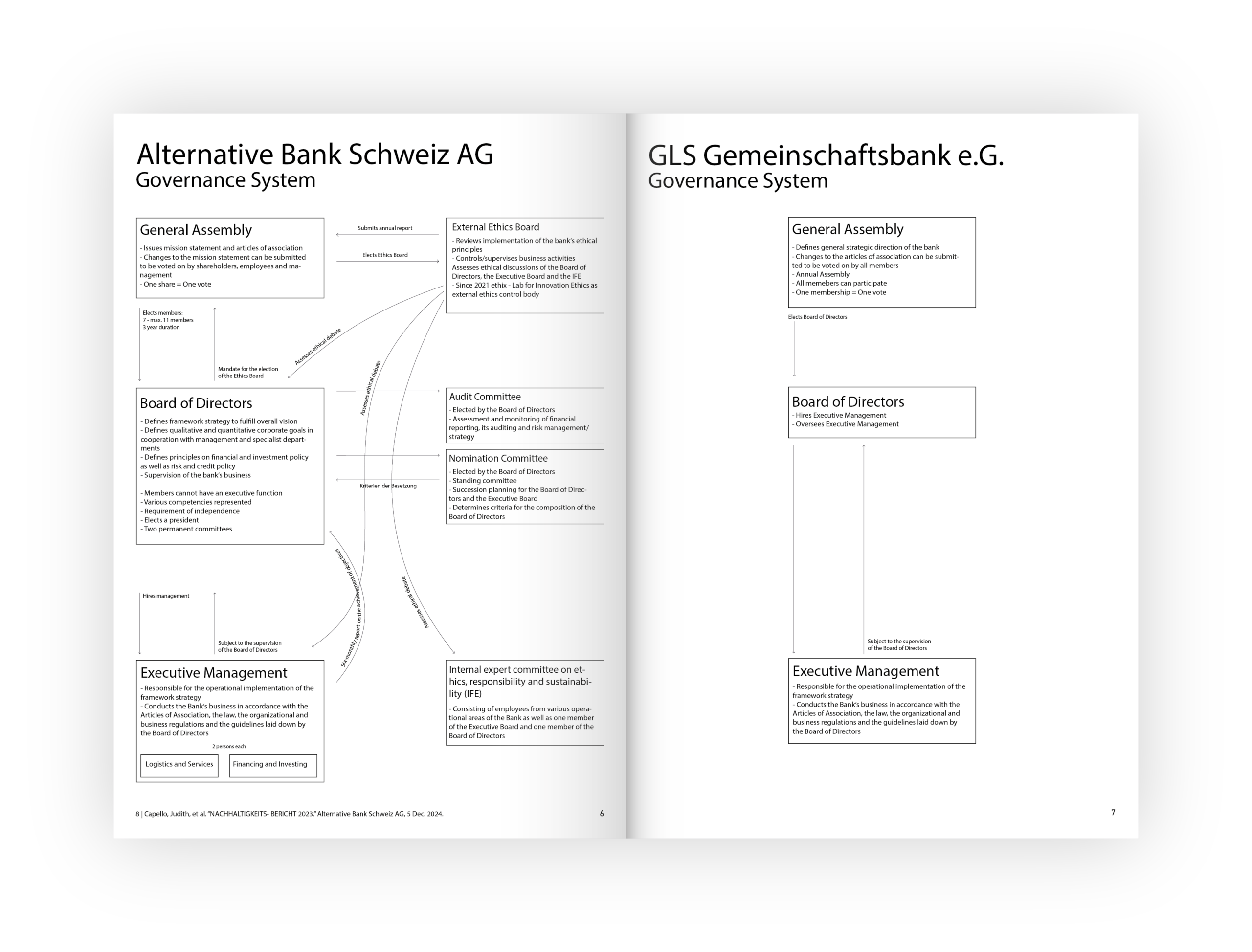
Along with large scale transformations brought about by climate crisis and political upheavels, the financial market also faces the need to adapt their overall strategies, accounting for new environmental and market risks. A sector within banking, which already sets environmental and social concerns at the center of their work are values-based banks. Instead of aiming at profit maximalization, these ethical banks have the goal of supporting industries and people, whose efforts benefit sustainability, social responsibility and local communities. Strategies which are common among ethical banks are a focus on the real economy over money markets, striving for longterm stability over shortterm profits, transparency with regards to their business activities and ambitions, as well as lasting relationships with their clients. While seemingly being similar regarding clinetel and aim, banks within the ethical banking sector vary in terms of their inner structure and legal base. This raises the question of how the impact of a bank is influenced by the way it is organized and therefore by the way decisions are being made. Within the ethical banking sector cooperatives are one segment. Is the impact in any way characterized by the cooperative model behind it? How much room does the banking system hold for the qualities a cooperative model promises, like active participation of the members? In order to investigate these questions, two banks are being compared as a Case Study: GLS Gemeinschaftsbank e.G. and Alternative Bank Schweiz AG. They are similar in that they both are part of the values-based sector with very similar topics of interest. They differ in size, but are still on a broad scale both rather small banks. While having different geographic contexts, Germany and Switzerland, the legal conditions in these countries are similar. They are both not listed companies. The main difference between the two banks, is that the ABS is a stock corporation, while GLS is a cooperative. The German GLS Gemeinschaftsbank e.G. was found in 1974, but originates in Non-Profit Trust Agency and later Credit Guarantee Cooperative dating back to 1961. Today, GLS has around 130 000 cooperative members. Alternative Bank Schweiz AG was found in 1990. It serves 43 000 customers and almost 10 000 shareholders are registered.
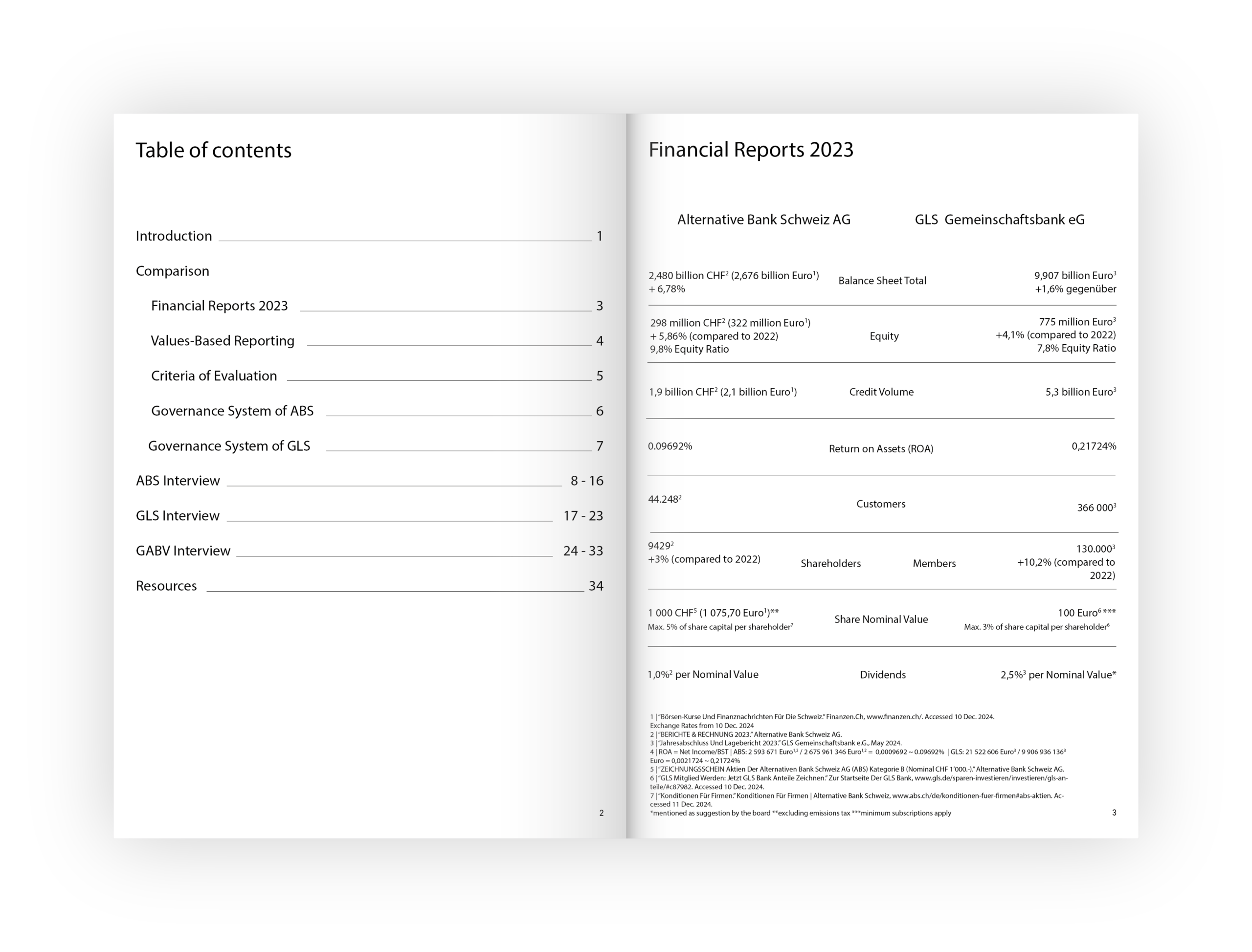
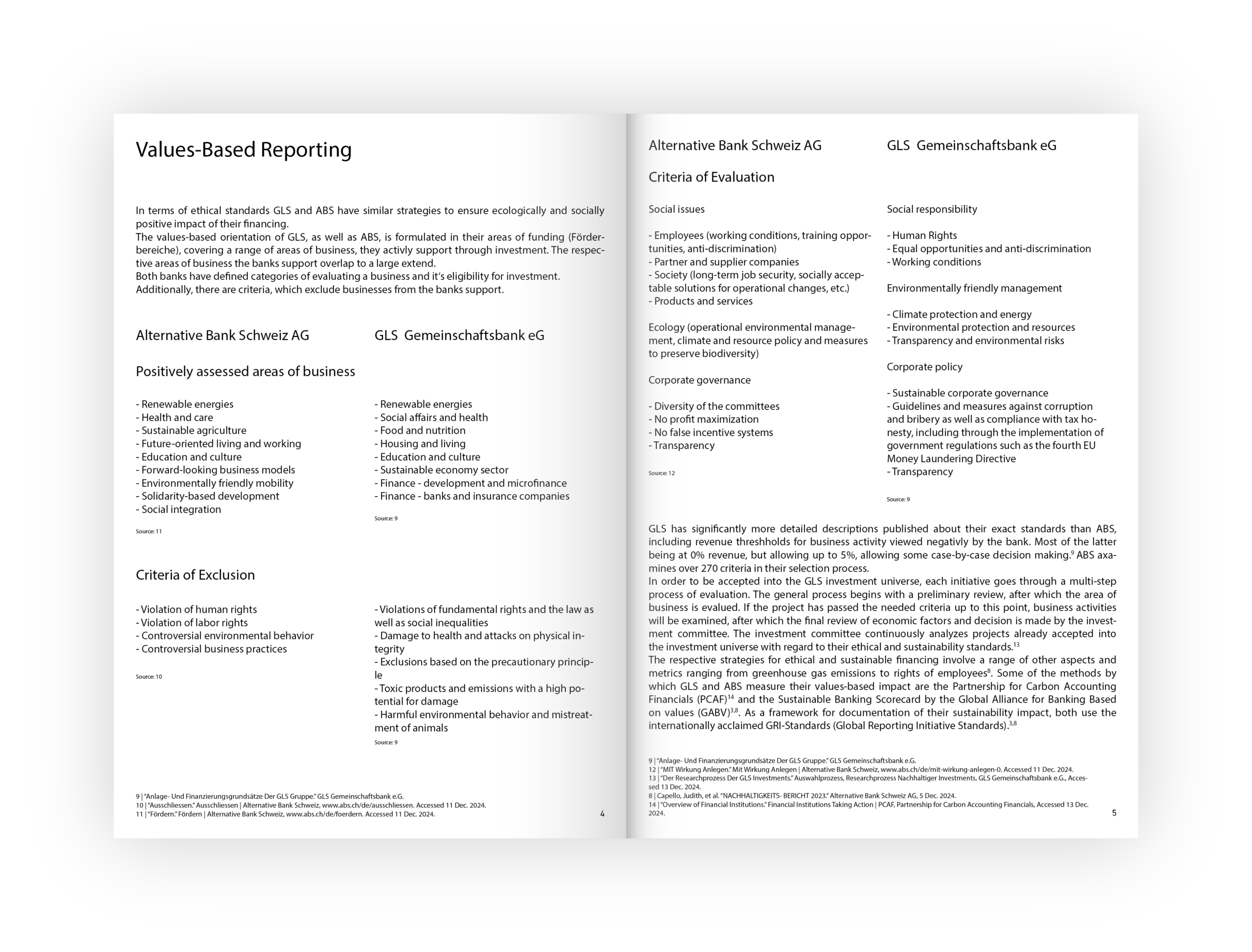
Along with large scale transformations brought about by climate crisis and political upheavels, the financial market also faces the need to adapt their overall strategies, accounting for new environmental and market risks. A sector within banking, which already sets environmental and social concerns at the center of their work are values-based banks. Instead of aiming at profit maximalization, these ethical banks have the goal of supporting industries and people, whose efforts benefit sustainability, social responsibility and local communities. Strategies which are common among ethical banks are a focus on the real economy over money markets, striving for longterm stability over shortterm profits, transparency with regards to their business activities and ambitions, as well as lasting relationships with their clients. While seemingly being similar regarding clinetel and aim, banks within the ethical banking sector vary in terms of their inner structure and legal base. This raises the question of how the impact of a bank is influenced by the way it is organized and therefore by the way decisions are being made. Within the ethical banking sector cooperatives are one segment. Is the impact in any way characterized by the cooperative model behind it? How much room does the banking system hold for the qualities a cooperative model promises, like active participation of the members? In order to investigate these questions, two banks are being compared as a Case Study: GLS Gemeinschaftsbank e.G. and Alternative Bank Schweiz AG. They are similar in that they both are part of the values-based sector with very similar topics of interest. They differ in size, but are still on a broad scale both rather small banks. While having different geographic contexts, Germany and Switzerland, the legal conditions in these countries are similar. They are both not listed companies. The main difference between the two banks, is that the ABS is a stock corporation, while GLS is a cooperative. The German GLS Gemeinschaftsbank e.G. was found in 1974, but originates in Non-Profit Trust Agency and later Credit Guarantee Cooperative dating back to 1961. Today, GLS has around 130 000 cooperative members. Alternative Bank Schweiz AG was found in 1990. It serves 43 000 customers and almost 10 000 shareholders are registered.
Mika Rock